
Introduction
Most companies would never fly a plane without a flight plan, yet many still run marketing with no written strategy at all. Campaigns launch, budgets get used, but there is no single digital marketing strategy template tying everything together. The result is scattered efforts, repeated work, and performance that feels random instead of repeatable.
At the same time, channels keep multiplying and AI tools appear every week, making it essential to reference resources like 11 Best Digital Marketing strategy frameworks that help organize the expanding landscape of options into manageable approaches. Without a clear plan, teams chase trends instead of moving toward defined outcomes. Research shows that companies with a documented strategy are far more likely to report success, as demonstrated in A Study on the Impact of Digital Marketing Strategies on consumers’ purchase intentions, which found that well-defined targeting significantly improves campaign performance. When that strategy combines classic marketing fundamentals with AI, marketing starts to operate more like a system than a series of experiments.
This guide walks through a complete, practical template any leadership team can use. At VibeAutomateAI, we use this same structure when we help clients design AI-supported marketing systems. By the end, you will have a clear blueprint for goals, channels, campaigns, budget, tech stack, and measurement that you can put into practice and improve quarter after quarter.
Key Takeaways
- A written digital marketing strategy template acts as a single source of truth that connects every activity to clear business goals and measurable targets.
- Four foundation blocks drive better decisions: SWOT, structured competitor research, clear buyer personas, and SMART goals linked directly to company targets.
- Most plans rely on a tight mix of website, SEO, content, email, paid media, and social, each with a defined role in the funnel.
- At any moment, marketing should lean toward one main lever: traffic, conversion, opportunity acceleration, or demand creation.
- AI tools speed up research, content, execution, and reporting, but humans still own strategy and quality.
- Treat the template as a living file you update at least quarterly, not a one-time document that sits in a folder.
What Is A Digital Marketing Strategy Template And Why Your Business Needs One
A digital marketing strategy template is a structured document that shows how your company will use online channels to hit business goals. It pulls together objectives, target audiences, channels, initiatives, budgets, and measurement in one clear plan, so teams are not starting from a blank page each time.
Without that framework, marketing becomes a stream of disconnected ideas: someone wants a webinar, someone else wants a new social account, another person pushes for more paid search. Each may be reasonable, but together they do not form a path to a defined outcome. A template shifts you from random acts of marketing to deliberate, sequenced moves.
For executives, the biggest benefits are control and transparency. When strategy lives only in people’s heads or scattered slide decks, you risk wasted spend and confusion when priorities shift or people leave. Once the plan lives in a shared template, AI tools can also read it and support execution through automation and analytics. At VibeAutomateAI, we see the strongest results when leaders set the strategy in the template and let AI handle repeatable tasks such as drafting, scheduling, and reporting.
The Six Critical Components Every Marketing Strategy Template Must Include

A marketing strategy template only works if it covers the right pieces. Six sections turn a simple plan into something teams can actually run:
- Executive Summary And Business Overview
Briefly explain where the company stands, main business priorities, core products or services, markets, and high-level revenue or pipeline targets. - Market Analysis And Competitive Intelligence
Capture industry trends, SWOT insights, and what key competitors are doing across channels. This keeps plans grounded in reality, not wishful thinking. - Audience Definition And Buyer Personas
Describe who you are trying to reach, what they care about, and how they behave online. Specific personas guide messaging and channel choices. - Goals, Objectives, And KPIs
Turn company aims into clear marketing goals with numbers and timelines. Pick a small set of KPIs that show if you are on track. - Channel Strategy And Tactical Initiatives
Decide which channels matter most right now and outline the projects you will run within each one, tied to a goal and persona. - Budget Allocation And Marketing Calendar
Show how money and time will be invested, and map initiatives onto a schedule with owners and deadlines so the plan feels real, not theoretical.
Building Your Foundation With Pre-Strategy Research And Analysis
Strong strategy rests on strong facts, which is why DIGITAL MARKETING STRATEGIES IN modern business environments emphasize data-driven decision making as the foundation for all planning activities. Skipping research usually means plans are based on internal opinions instead of customer reality.
A simple foundation for your digital marketing strategy template includes:
- Business And SWOT Analysis – List strengths, weaknesses, opportunities, and threats, with an eye on digital channels (site, content, data, and brand strength online).
- Competitive Review – Study 5–7 serious competitors. Look at their websites, search visibility, content themes, ads, and social activity to spot gaps and patterns.
- Market Positioning – Write a clear statement of your main promise, why someone should choose you, and which segments care most.
- Baseline Metrics – Record current traffic, leads, conversion rates, deal volume, and customer value across channels as your starting line.
AI can speed this work considerably. Tools can scan competitor sites, summarize reviews, and assemble dashboards. At VibeAutomateAI, we use an AI-supported research process that cuts manual hours while still feeding clean insight into the template, with humans making the final calls.
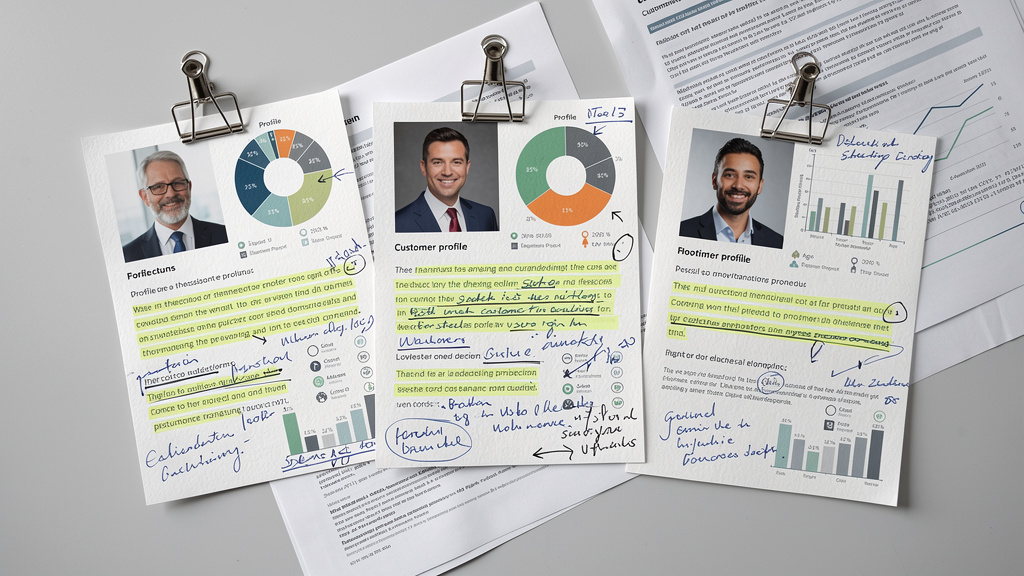
Defining Your Target Audience And Creating Actionable Buyer Personas
Labels like “small business owners” or “enterprise leaders” are too broad to guide good marketing. Within those groups are very different people with different pressures, budgets, and success measures.
We start by separating:
- Target Markets – Broad groups such as mid-sized manufacturers in the US.
- Buyer Personas – Detailed sketches of decision-makers and influencers, such as an operations director under pressure to cut costs without hurting output.
Effective personas blend numbers and stories. Combine:
- CRM and purchase data
- Website and email behavior
- Interviews and surveys
- Feedback from sales and support teams
Each persona should cover role, goals, key metrics, daily responsibilities, main pain points, buying triggers, information sources, and common objections. Most companies only need three to five primary personas to start; more than that spreads content and budget too thin.
AI helps by clustering customers with similar behavior, spotting recurring phrases in feedback, and highlighting attributes common in high-value deals. VibeAutomateAI feeds these insights into an audience framework so personas stay current rather than frozen in time.
“Marketing is no longer about the stuff that you make, but about the stories you tell.” – Seth Godin
Detailed personas make those stories specific instead of generic.
Setting SMART Marketing Goals That Drive Business Outcomes
A digital marketing strategy template without clear goals is just a narrative. To guide real decisions, it has to spell out what success means in numbers linked to the business scoreboard.
Work backward from top-line objectives. If the company wants to grow revenue by 20%, marketing can estimate how many additional customers and deals that implies, then calculate the number of leads and level of traffic needed based on known conversion rates. These figures become SMART goals: specific, measurable, achievable, relevant, and time-bound.
For example: “Increase organic visits to product pages by 10,000 per month by the end of Q2 to drive demo requests.” This ties a channel metric to a business result, not just a vanity number.
Separate:
- Outcome Goals – Revenue, qualified pipeline, new customers, retention.
- Activity Goals – Number of articles, webinars, or emails.
A simple hierarchy in the template—company objectives → marketing objectives → channel goals → initiative-level KPIs—keeps everything aligned. AI can estimate what is realistic based on past data and refresh dashboards automatically. As Peter Drucker put it:
“What gets measured gets managed.”
Selecting And Optimizing Your Core Digital Marketing Channels

Trying to be everywhere at once is a fast way to burn out a team. It is better to pick a small set of core channels that match your personas, goals, and resources, then double down on those.
Key questions:
- Where do your best buyers actually spend time online?
- Which channels are best suited to the actions you want (signups, demos, direct purchases)?
- How much budget and staff time can you commit for at least 6–12 months?
Most B2B and B2C plans revolve around:
- Website – Your main “hub” for education and conversions. It should load quickly, work well on mobile, and guide visitors toward clear next steps.
- SEO – Long-term traffic from people searching for what you offer. Focus on helpful content around the phrases your personas use.
- Content Marketing – Articles, guides, case studies, videos, and tools that educate and move people closer to a decision.
- Email Marketing – High-ROI channel for nurturing, onboarding, and reactivation, with segmentation and automation built in.
- Paid Media – Search and social ads to speed up traffic and testing while organic programs ramp up.
- Social Media – Awareness, community, and thought leadership, depending on your model.
We usually recommend three to five active channels. VibeAutomateAI clients often use AI to repurpose content across channels, improve targeting, and run faster tests without adding more platforms.
Creating Your Strategic Initiatives And Campaign Blueprint
Once channels and goals are clear, you need specific projects that will bring the strategy to life. We call these strategic initiatives, and they are the building blocks of your campaign blueprint.
Each initiative in the template should include:
- Main deliverable (for example, 10 SEO articles, a quarterly webinar series, a product-focused paid search campaign).
- Target persona and funnel stage.
- Linked SMART goal and primary KPIs.
- Key steps for execution (research, drafting, design, approvals, launch, follow-up).
- Owner, timeline, and budget.
Group initiatives by funnel focus:
- Traffic – SEO content, reach-focused ads, guest articles, partnerships.
- Conversion – Landing page tests, new lead magnets, on-site prompts.
- Nurture – Email sequences, webinars, remarketing.
- Demand And Brand – Thought leadership reports, events, collaborations.
Because ideas always exceed capacity, prioritization matters. Focus first on the part of the funnel that is most constrained (you will formalize this with the four-lever framework later). AI tools assist by drafting content, building variants for tests, and automating reminders so humans can focus on strategy and editing.
Allocating Your Marketing Budget For Maximum ROI
Even the sharpest strategy fails without clear budget choices. A budget section in your digital marketing strategy template turns vague guessing into a repeatable model.
Start with the total amount you can invest for the quarter or year. Map that against priorities: new markets, short-term pipeline, or retention. A simple 70/20/10 split works well:
- 70% for proven tactics that already perform well
- 20% for optimization and testing on those core programs
- 10% for controlled experiments in new approaches or channels
Cover major categories such as:
- Content and creative production
- Technology and data tools
- Paid media
- Staff and agencies
- Events or sponsorships (if relevant)
Remember that channels behave differently: SEO and content need upfront investment but can compound over time, while paid media gives fast feedback but stops when spend stops. AI can model expected returns at different spend levels and adjust bids and budgets automatically based on performance. VibeAutomateAI often helps teams focus limited funds on a tight mix of SEO, content, email, and a few high-intent paid campaigns.
Building Your Marketing Calendar And Operational Workflow

A strategy only matters when it shows up on calendars with names and dates. Your marketing calendar is the bridge between the template and weekly work.
Plan at three levels:
- Quarterly – Major campaigns and themes.
- Monthly – Key deliverables such as articles, webinars, and ad flights.
- Weekly/Daily – Tasks in your project management tool.
Each calendar entry should include:
- Initiative or campaign name
- Specific deliverable
- Milestones (draft, review, launch)
- Owner and collaborators
- Dependencies and required resources
Align the marketing calendar with product releases, sales pushes, and major industry events to avoid clashes and missed opportunities. Connect it to tools like Asana, ClickUp, Slack, or Teams so updates flow automatically. AI can create standard task lists for recurring campaign types, assign work based on capacity, and generate status reports without manual chasing—something VibeAutomateAI often sets up during rollout.
Defining KPIs And Building Your Performance Measurement Framework
Measurement is where strategy earns trust. Many teams track surface-level metrics like page views or followers that look nice but do not map to business results. Your template needs a clear performance framework.
Use a simple KPI hierarchy:
- Business Metrics – Revenue growth, new customers, retention, margin.
- Marketing Metrics – Qualified leads, marketing-sourced revenue, cost per acquisition.
- Channel Metrics – Web, SEO, email, paid media, and social metrics.
- Initiative Metrics – Landing page conversion, webinar attendance, asset-level lead generation.
Many companies also choose a single North Star metric—such as monthly recurring revenue or qualified pipeline—that best reflects marketing’s impact at the current stage.
Define a short list of core KPIs per channel. For example:
- Website: sessions, bounce rate, conversion rate by source.
- SEO: organic traffic growth, rankings for target phrases.
- Email: list growth, open and click rates, conversions.
- Paid Media: cost per click, conversion rate, cost per acquisition, ROAS.
- Social: reach, engagement, clicks, assisted conversions.
Set a review rhythm—daily checks for critical paid campaigns, weekly channel reviews, monthly performance meetings, and quarterly strategy sessions. AI can pull data into live dashboards, flag anomalies, and help explain what changed so you can decide what to do next.
Choosing Your Strategic Focus With The Four Marketing Levers Framework
A complete digital marketing strategy template often lists dozens of possible initiatives. The hard part is focus. To avoid spreading effort too thin, we use a simple four-lever framework to decide what matters most right now.
- Lever 1: Traffic Generation (Top Of Funnel)
Use when your site converts well but too few people see it. Think SEO content, reach-focused ads, guest publishing, and partnerships. - Lever 2: Conversion Optimization (Middle Of Funnel)
Use when you have traffic but visitors rarely convert. Priorities include landing page tests, better offers, simplified forms, and stronger lead magnets. - Lever 3: Opportunity Acceleration (Bottom Of Funnel)
Use when leads stall or close slowly. Focus on nurture sequences, case studies, ROI tools, and tighter marketing-to-sales handoffs. - Lever 4: Demand Creation And Brand Authority
Use when the funnel works but too few high-fit prospects even know you exist. Look at research reports, speaking, PR, communities, and partnerships.
Pick one primary lever for each quarter based on data, then align most initiatives and budget around it. VibeAutomateAI often uses AI-supported analytics to help diagnose which lever will have the biggest impact at a given moment.
Integrating AI Automation Into Your Marketing Strategy Execution
AI is now a practical workhorse for marketing teams, especially when it follows a well-documented digital marketing strategy template. It should act as an execution engine, not a replacement for strategy or human judgment.
Good candidates for AI support include:
- Drafting first versions of blog posts, emails, ads, and social copy
- Researching topics and suggesting related phrases for SEO
- Tagging leads, updating records, and routing requests
- Building dashboards and recurring reports
- Managing bids and budgets for paid campaigns
- Powering chatbots for simple questions and early-stage lead qualification
Humans still provide briefs, review for accuracy and tone, and make trade-offs. The best results come from a phased approach: pick one high-value use case (for example, content drafting or reporting), prove value, then expand. VibeAutomateAI partners with teams to match AI tools to specific needs in their template and to put sensible guardrails around data, brand voice, and approvals.
Building Your Technology Stack Essential Tools For Strategy Execution
Many teams drown in tools that do not connect well, leaving data scattered and budgets wasted. Your technology stack should be the minimum set of platforms that actually support the strategy in your template.
Start with what you need the tech to help with:
- Managing campaigns and content
- Capturing and nurturing leads
- Tracking performance
- Automating routine work
Most organizations benefit from:
- Marketing Automation + CRM – Platforms such as HubSpot or Salesforce Marketing Cloud to centralize contact data, run email flows, and connect to sales pipelines.
- Content Management System (CMS) – Tools like WordPress or Webflow to manage your website, blog, and basic SEO settings.
- SEO And Content Tools – For example, Semrush or Ahrefs for research and monitoring.
- Email And Social Tools – Mailchimp for email; Hootsuite or Buffer for scheduling and engagement tracking.
- Analytics And Project Management – Google Analytics 4 plus tools like Asana or ClickUp to keep initiatives moving.
- AI Content And Automation Tools – Systems such as Jasper AI or ChatGPT to support writing and workflows across channels.
Integration is more important than sheer feature lists. Data should move cleanly between systems so reporting and automation work without constant CSV exports. VibeAutomateAI helps clients pick a small set of core tools that align with their strategy and avoid tool sprawl.
Implementing Your Strategy The Eight Step Rollout Plan
Many organizations write thoughtful strategies that never get fully adopted. To move your digital marketing strategy template from document to daily practice, use an eight-step rollout plan:
- Secure Executive Sponsorship – Align leadership on goals, budget, and expectations so the plan has visible backing.
- Set Governance And Accountability – Define who owns the strategy, who leads each channel, and how decisions are made.
- Train The Team – Make sure everyone understands the plan, their role, the tools, and how success will be judged.
- Configure Technology And Integrations – Set up core platforms, connect data, build key automations, and document settings.
- Launch Pilot Initiatives – Start with a few projects that represent different parts of the strategy, measure them closely, and refine.
- Lock In Measurement Rhythms – Stand up dashboards, agree on weekly and monthly reports, and schedule review meetings.
- Scale What Works – Expand effective pilots, standardize winning processes, and pause or fix weak initiatives.
- Commit To Ongoing Improvement – Refresh personas, update the template, and tweak workflows as you learn over 3–6 months.
VibeAutomateAI often supports clients through each step with templates, checklists, and coaching so the plan turns into lasting habits instead of a one-off project.
Measuring Success And Continuously Optimizing Your Strategy
A static strategy goes stale quickly. The best digital marketing strategy templates are living documents that reflect a simple loop:
- Measure performance against the KPIs and goals in the template.
- Analyze which channels, campaigns, and messages are working—and why.
- Design small tests to improve weak areas or double down on strengths.
- Run those tests, measure again, and feed results back into the plan.
Use different review tempos:
- Daily: Paid campaigns, critical conversion paths, uptime.
- Weekly: Channel trends, top content, lead quality.
- Monthly: Progress vs. goals, budget pace, initiative status.
- Quarterly: Persona accuracy, competitive shifts, tech stack fit, and which main lever to focus on next.
Set aside 10–20% of budget for controlled experiments while protecting the core. AI can monitor metrics in near real time, trigger alerts when performance drifts, and automate testing of creative and audiences. VibeAutomateAI connects these tools back to your strategy so changes stay aligned with real business goals.
Common Digital Marketing Strategy Mistakes And How To Avoid Them
Learning from others’ missteps can save a lot of time and budget. Common mistakes we see include:
- Building Strategy Around Tools Instead Of Goals – Define goals and audience needs first, then pick tools that support that plan.
- Shallow Buyer Personas – Go beyond titles and firmographics; invest in real research and behavior data.
- Trying To Be Everywhere – Focus on three to five core channels where your audience actually engages.
- Vague, Unmeasured Goals – Replace “more awareness” with numeric targets and dates tied to business results.
- Ignoring Data Quality – Fix tracking and data hygiene before leaning on advanced analytics or AI.
- Poor Marketing–Sales Alignment – Agree on what a qualified lead is, share dashboards, and review pipeline together.
- Underestimating Content Requirements – Match content plans to realistic production capacity (including AI support).
- Skipping Documentation – Write down recurring processes and campaigns so knowledge does not walk out the door.
- Misusing AI – Avoid both extremes of automating everything or refusing AI entirely; start with clear, high-value use cases.
- Set-And-Forget Strategy – Schedule quarterly reviews so your template stays aligned with your market and business.
VibeAutomateAI builds these lessons into its guidance so clients can skip many of the hard knocks and move faster toward predictable performance.
Conclusion
A complete digital marketing strategy template is more than a document. Used well, it becomes the operating manual for how your company attracts, converts, and keeps customers across online channels. It connects business goals, buyer insight, channel choices, campaigns, budgets, technology, and measurement so every move has a clear reason.
We have walked through each major piece of that template—from foundation research and personas to SMART goals, channel strategy, initiatives, budget planning, calendars, KPIs, optimization cycles, tech stack design, and the four-lever focus framework. Layered through all of it is the role of AI, which can remove manual drudgery, speed content and campaign work, and surface insight far faster than human teams alone.
At VibeAutomateAI, we see the strongest results when leaders treat this template as a living guide they refine with data and experience. If your marketing currently feels scattered or hard to measure, adopting a clear template backed by thoughtful AI use can bring order, speed, and confidence to your next quarter and beyond.
FAQs
How Detailed Should A Digital Marketing Strategy Template Be
Aim for clear and complete, not bloated. Your template should cover goals, personas, channels, initiatives, budget, tech stack, and KPIs in enough detail that a new team member could understand the plan within an hour. Deeper process docs and campaign playbooks can live in linked files.
How Often Should We Update Our Digital Marketing Strategy Template
Review the template at least once per quarter. Refresh metrics, adjust goals, refine personas, and record lessons from recent campaigns. Smaller updates can happen monthly as you add initiatives or tweak budgets. Treat it as a living document that grows with your business.
Can Small Businesses Use The Same Template As Large Enterprises
Yes. The structure works for any size; only the level of detail and number of initiatives change. A small business might focus on one or two personas and three main channels, while an enterprise might manage many segments. The key is to scale activity, not skip sections.
Where Does VibeAutomateAI Fit Into This Template
VibeAutomateAI acts as a strategic partner across several parts of the template. We help leaders define goals, clarify personas, and choose channels, then match AI tools to the tasks that benefit most from automation. Our guides cover research, rollout, and measurement so AI supports the plan instead of distracting from it.
What Is The First Step If We Do Not Have Any Formal Strategy Yet
Start simple. Write down your business goals, current channels, and best guess at target personas in a basic digital marketing strategy template. Then run a short research phase to validate or correct those assumptions, set a few SMART goals, and pick one main lever to focus on for the next quarter. As you gain data and experience, you can fill in the rest of the template and, with support from partners like VibeAutomateAI, add AI where it has the highest impact.
Stay connected